
Updated September 18, 2026
Duvet or comforter? Both keep a bed warm and inviting, but they are not quite the same. A duvet is a removable insert used inside a washable cover, while a comforter is a single quilted layer that is normally used as it is. The best choice depends on how you like to make your bed, wash your bedding and change the look of your bedroom.

What is the difference between a duvet and a comforter?
The simplest difference is construction. A duvet is a soft insert filled with down, feathers, wool or synthetic fibres. It sits inside a separate duvet cover. A comforter combines the outer fabric and filling in one stitched or quilted piece.
That distinction changes how each option is washed, styled and used. A duvet cover can be removed and laundered with the rest of your bed linen. A comforter usually needs to be washed as a complete item, so its care depends on its size, filling and manufacturer’s instructions.
What is a duvet?
A duvet is designed to provide warmth without several heavy layers. The insert slips into a duvet cover, much like a pillow fits inside a pillowcase. Ties, loops, buttons or a zip can help keep the insert in place.
Because the cover is removable, you can wash it regularly and change the colour or texture of your bed without replacing the insert. In Australia, a duvet is commonly called a doona, and the cover a doona cover.
What is a comforter?
A comforter is a filled bed covering with the shell and insulation permanently joined together. Stitching keeps the filling distributed across the surface. It is often placed over a flat sheet and may be combined with throws or blankets when extra warmth or texture is wanted.
In North America, the word comforter is sometimes used loosely for any thick bed covering, which is why product descriptions can seem confusing. Always check whether the item has a removable cover and read its care label.
Duvet vs comforter at a glance
| Feature | Duvet | Comforter |
|---|---|---|
| Construction | Insert plus removable cover | One quilted, filled piece |
| Everyday washing | Cover is easy to remove and wash | The whole item usually needs washing |
| Styling | Change the cover for a new look | One fixed colour or pattern |
| Bed making | Simple, minimal layering | Often used with a top sheet |
| Warmth | Choose an insert weight for the season | Warmth is fixed by its filling |
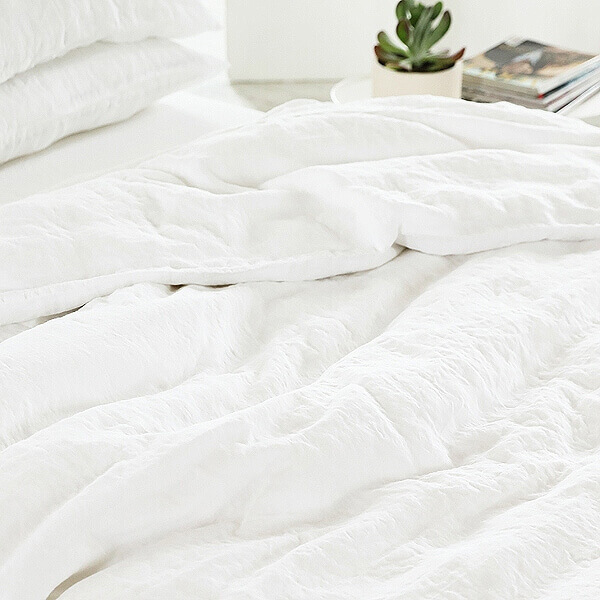
Advantages of a duvet
- Its removable cover is easier to wash than a complete filled comforter.
- You can refresh the bedroom by changing only the cover.
- Different insert weights can suit summer, winter or year-round use.
- A duvet can simplify bed making because fewer layers are needed.
- A breathable linen cover feels comfortable in both warm and cool weather.
Possible drawbacks of a duvet
- The insert can shift or bunch if it is not secured inside the cover.
- Putting on a duvet cover takes a little practice.
- The insert may require specialist cleaning, depending on its filling.
- Sizes vary between countries, so the insert and cover must be compatible.
Advantages of a comforter
- It is ready to place on the bed without fitting a separate cover.
- Its stitched construction helps the filling stay evenly distributed.
- It creates a traditional, generously layered look.
- It may stay in place more easily when used over a top sheet.
Possible drawbacks of a comforter
- A bulky comforter may not fit in a domestic washing machine.
- Changing the bedroom colour scheme normally means changing the whole comforter.
- Its warmth cannot be adjusted without adding or removing other layers.
- Repeated washing can flatten or clump some fillings.
Is a duvet or comforter easier to care for?
For most households, a duvet with a removable cover is the easier option. The cover protects the insert from everyday contact and can be washed more often. Always follow the care instructions for both pieces, and make sure they are completely dry before returning them to the bed.
A comforter can also be practical if its care label allows machine washing and your machine is large enough. Avoid forcing bulky bedding into a small drum, as this prevents effective cleaning and rinsing.
Which is better for hot sleepers?
Neither name alone guarantees a cooler night. Look at the filling weight, fibre content and outer fabric. A lighter insert combined with a breathable linen duvet cover allows air to circulate and helps moisture evaporate. A heavy synthetic comforter may retain more heat, although lightweight comforters are also available.
Which option does LinenMe prefer?
Both can make a comfortable bed, but we favour a duvet and removable linen duvet cover. It is an adaptable combination: easy to refresh, straightforward to care for and simple to style with linen sheets, cushions and a throw. Linen’s natural texture also means the bed looks relaxed and inviting without needing perfect creases.

Frequently asked questions
Can you use a duvet without a cover?
You can, but a cover protects the insert and is normally much easier to wash. Using a cover can therefore extend the useful life of the duvet.
Do you need a top sheet with a duvet?
No. Many people use a fitted sheet and a covered duvet only. Others prefer a flat sheet for an additional washable layer.
Can a duvet cover be used as a comforter?
An empty duvet cover has no insulating filling, so it will not provide the same warmth. In very warm weather, however, some people enjoy using an empty linen duvet cover as a light layer.
How do you stop a duvet from moving inside its cover?
Choose a correctly sized insert and cover, then fasten any internal ties or loops. Shaking the duvet from the top corners after washing also helps redistribute it evenly.
Explore LinenMe’s pure linen duvet covers and coordinated linen bedding, created for a naturally comfortable and beautifully relaxed bedroom.
Wonderful, soft, high-quality duvet vs comforter. I absolutely love this!