
Updated: 16 September 2026 — This article has been reviewed and expanded for accuracy.
Most modern linen clothing and home textiles can be washed safely at home. Linen fibres are naturally strong and usually become softer and more comfortable with repeated washing. The right method, however, depends on the item's construction, colour, finish and whether the fabric was pre-washed.
The care label always takes priority. Fragile antique linen, unstable dyes, tailored garments and heavily embroidered or embellished pieces may require hand washing or specialist treatment.
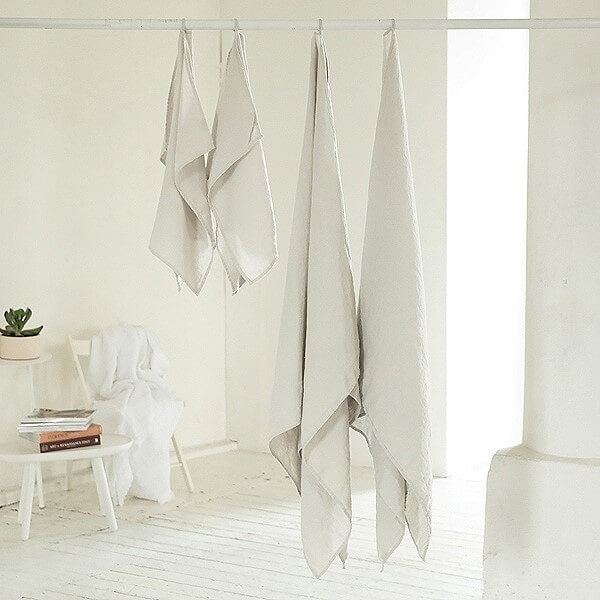
What to check before washing linen
- Read the care label and follow its temperature, cycle and drying instructions.
- Separate whites, light colours and dark colours.
- Fasten closures, turn garments inside out and place delicate pieces in a laundry bag.
- Wash linen separately from heavy or abrasive items and do not overload the machine.
- Test stain treatments on a hidden area first.
Untreated linen may shrink during its first wash. Pre-washed linen generally has less residual shrinkage, but excessive washing or drying heat can still alter its dimensions. If you are sewing with linen fabric, pre-wash it using the method you intend to use for the finished piece.

What temperature should you wash linen at?
For everyday coloured linen and lightly soiled items, 30°C or a cool-to-lukewarm wash is usually the cautious choice. Many robust, colourfast linen products can be washed at 40°C when their care label allows it.
Some sturdy white household linens may permit a 60°C wash. This can be useful when a higher hygiene temperature is genuinely needed, but it should never override the label. Frequent high-temperature washing increases fibre wear, fading and shrinkage. A 90–95°C wash is unsuitable for most modern linen products unless the manufacturer specifically states otherwise.
How to treat stains before washing
Blot fresh spills with a clean white cloth rather than rubbing. Rinse water-based stains from the reverse with cool water where appropriate, then apply a small amount of mild detergent or a stain treatment approved for the textile.
Avoid chlorine bleach because it can weaken linen fibres and alter colour. Do not mix vinegar, baking soda, bleach, ammonia or commercial stain products. Heat can set some stains, so make sure the mark has gone before tumble drying or ironing.
How to machine wash linen
Choose a gentle cycle, the temperature stated on the care label and a mild detergent. Leave enough space in the drum for the fabric to move and rinse properly. Wash delicate linen separately from denim, exposed zips, hooks and other abrasive items.
Powder residue can be visible on dark linen, so dose detergent carefully and use an extra rinse only when necessary. Fabric softener is generally unnecessary: linen softens naturally with washing, and product build-up can reduce absorbency in towels and kitchen textiles.
How to hand wash linen
Fill a clean basin with cool or lukewarm water and add a small amount of mild detergent. Move the item gently through the water without scrubbing, twisting or wringing. Rinse thoroughly, support the full weight of the wet textile when lifting it and press out water gently between clean towels.
Hand washing is not automatically safe for antique or structurally weak linen. Valuable vintage pieces, unstable dyes and intricate embroidery should be assessed by a textile conservator or reputable specialist cleaner.
Washing different types of linen
Linen bedding
Wash sheets and duvet covers with similar colours and avoid packing the drum tightly. Close duvet-cover fastenings and remove the bedding promptly after the cycle to reduce deep creases.
Linen clothing
Fasten buttons or zips, turn garments inside out and use a gentle cycle. Tailored jackets, lined garments and pieces marked for professional cleaning should not be treated like an unstructured linen shirt or dress.
Table linen and kitchen linen
Treat food, grease and wine marks promptly, then wash according to the label. White table linen may tolerate a warmer wash than dyed or decorative pieces. Avoid drying a stained cloth until the mark has disappeared.
Vintage, embroidered and hemstitched linen
Check for weak fibres, colour bleeding and loose threads before washing. Support delicate pieces fully when wet, avoid vigorous agitation and seek specialist advice for valuable or historic textiles.
How to dry linen
Air drying is gentle and energy efficient. Shake the item, reshape it and hang it or lay it flat according to its construction. Keep strongly coloured linen away from prolonged direct sunlight, which can fade dyes.
If the label permits tumble drying, use a low temperature and remove the item while it is still slightly damp. High heat and over-drying increase stiffness, creasing and shrinkage.

How to reduce wrinkles
Remove linen promptly from the washer, shake it well and smooth seams and edges before drying. Natural creases are part of linen's relaxed character, so ironing is optional. For a smoother finish, iron while slightly damp using steam and the temperature specified on the care label. Press dark colours from the reverse and use a clean pressing cloth over embroidery.
Common questions about washing linen
Can linen be washed in a washing machine?
Yes. Most modern linen can be machine washed unless its care label specifies hand washing, professional cleaning or another method.
Can linen be washed at 40°C?
Often yes, provided the care label permits it. For dark colours, delicate items or lightly soiled linen, 30°C may be preferable.
Can linen be washed at 60°C?
Only when the care label allows it. Some robust white household linen can tolerate 60°C, but routine high-temperature washing causes more wear and may increase shrinkage.
Does linen shrink?
It can, especially during the first wash if the fabric was not pre-washed. Excessive heat during washing or tumble drying increases the risk.
Can linen go in a tumble dryer?
Only when the label allows it. Use low heat and remove the item while it is still slightly damp.
Can bleach be used on linen?
Avoid chlorine bleach. Use mild detergent and a colour-safe, linen-compatible stain treatment when needed.
For more advice, read How to Care for Linen Fabric or browse our linen bedding.
2021-09-02
2021-08-30
We read your blog and it is very beautiful and the content is also good, you have well-described about the fabric and I liked it so thank you, Washing 100% cotton with cold water can purpose shrinkage so in case you need the cotton to be shriveled intentionally use natural water in any other case regular water is the best. Does 100% cotton shrink? While washing cotton with inside the machine, mild cycle and chemical-loose detergents are recommended? For heavy grimy clothes, you may use warm water. Cotton is a vegetable-primarily based totally fiber that comes from the seed pod of cotton plants. It is taken into consideration to be the workhorse of the material world.
2019-12-13
I bought a thick fabric, linen dress which is exactly in my size. Label mentioned 55% cotton & 45% linen. Also mentioned hand wash cold, cool iron only. Label didn't note as pre-washed. Will it shrink after first wash more than 5%? Do I need to exchange it to next size before wearing as a alternative?
Thank you..
2019-11-26
Hi, my linen bedding sheets (am pm) are shedding lint like nothing despite repeated washings (nearly 6 times now). It is particular obvious when I wake up every morning, with tiny lint stuck all over my T-shirt. I have an air filter in my room (as I suffer from bad allergies) which goes crazy every time the bedding is stirred, and I fear that the tiny particles that were stirred up will be breathed in and cause harm.
Could you please Let me know if this is normal with linen beddings?
2019-07-21
Hi
I have some 100% linen bed sheets. The instructions were to wash at 30C. I've been doing so for a couple of years. But I need to wash them at 60C to kill dust mites that my partner is allergic to. The linen's dust mite resistance is why I bought them in the first place. But I guess time has caught up with them. Allergy UK say that washing at 60C is the only way to completely kill the mites. Your article says washing at 60c is ok but all the comments say to wash at lower temperatures.
I'm a bit scared as they were very expensive and I adore them.
Any suggestions would be great.
Thanks
2019-06-13
2018-11-12
2018-10-29
Hi!
I am about to make linen cushion covers and my plan is to pre-wash the fabric. How will that change the feel of the linen? Is it just personal preference? I don't think I want to always take them to the dry cleaners, so am leaning toward pre-washing.
Thank you for your thoughts on this. I have very little experience working with linen.
Sue
2018-07-23
2018-04-24
2018-03-06
2018-02-11
2018-01-07
2018-01-08
Dear Martha,
Sorry to hear about this accident. Unfortunatelly there is no magic way to reverse it. You could wash it and hang still a bit wet (that could bring a bit length back, but not much). Linen fabric shrinks when you wash it for the first time. The % would depend on the weave and manufacture. LinenMe clothes are all made from prewashed fabric, so the shrinkage would be very minimal or none. Nevertheless you have you still have to be very careful with temperatures on both: washing machine and the dryer - always use the lowest possible temperatures.
Inga
2018-01-03
I recently purchased a huge grey linen tablecloth with 16 napkins to match for Thanksgiving dinner.
Needless to say, there are lots of grease stains that will not come out in the wash. I feel I cannot use it anymore because it looks awful!
Please suggest how to launder and remove stains?
Thank you,
Jayne
2018-01-05
Dear Jayne,
Thank you for your note. First I would suggest to get manufacture recommendations for this as it it might differ depending on the composition and quality of fabric. For good quality linen tablecloth we have some recommendations in this article how to get the grease stains out. Hopethis helps.
Regards,
Inga
2017-11-11
2017-11-12
Dear AJ,
The lint is usually caused not by how you wash it, but by the quality of yarns used to make linen fabric and the type of the weave. The looser the weave of the fabric the more chances that you will have some lint. Dryer usually helps to "collect" most of the lint (make sure you use low temperatures though), but it doesn't solve the root cause. If the quality of linen fabric is good then the lint should disappear after cuple of washes. If the quality of linen yarns used to weave the fabric was poor then the lint issue will really continue for a while (it should be less and less with every wwash though).
Inga
2017-11-11
Dear Inga,
I just bought a lovey French daybed which had newly been recovered with a natural linen cushion cover. It has a zipper thankfully. It was left in the truck overnight and a window was open. Of course it rained! There is a water mark which covers more than half of one side. There are no instructions.. Should I wash it in my very large machine or should I bring it to the dry cleaner and ask them to wash it? I am not sure if it needs to be treated first but it is not a horrible stain, just a watermark. Kind regards, Donna
2017-08-12
2017-08-13
Dear Max,
Please check the shirt washing instructions. If there are no bleaching warnings on the label then I would suggest oxygen-based bleach. Soaking over night would be recommended before washing. Be careful with washing temperatures as you are dealing with linen here, so don't exceed max recommended temperature that is indicated on the shirt's care label.
Inga
2017-08-04
2017-08-05
Dear Kathy,
I believe you won't avoid washing your dress in order to take out those spots. It doesn't sound that they are very tough stains, so I suggest you don't use any special stain removers. Here is good article with tips on how to wash your linen clothes.
Inga
2017-08-01
I accidentally washed several fine Italian linen shirts at 90°C in the washing machine thinking it was a 30°C program. How much do you think they shrank by in percentage terms? Do you think that if I wash them in cold water a couple times that they may loosen up the fibers? Thank you for taking the time to answer :-)
2017-08-02
Dear Randal,
I'm afraid I won't have any good news for you. The shrinkage would depend on a weave of the fabric, but it could be even up to 15%-20% if it was made from not pre-washed fabric (LinenMe linen shirts are made from pre-washed). Washing in cold water I'm afraid won't reverse the shrinkage effect. You most probably could get a cm back (in length) by hanging still a bit wet shirts after washing on the hanger (but if they shrunk dramatically it probably won't help much).
Inga
2017-07-30
2017-07-26
2017-07-31
Dear Rone,
If you wash your linen pants for the first time and manufacture didn't use pre-washed fabric to make those pants then you will have shrinkage effect anyway (if you do machine washing or handwash. If the fabric was pre-washed then you are perfectly fine washing it in the machine as you described.
Inga
2017-07-21
2017-07-13
I am attending a summer wedding in 2 weeks. I checked my cream linen suit to see if it needed cleaning as I haven't worn it for 4 years and there are some faint light brown stains that I thought were maybe beer splashes from the last time I wore it. As the label suggests dry cleaning that's where I took it. He said he doesn't think the stains will come out as they are damp spots but he will try anyway. If unsuccessful, could I dye it a light brown or blue to cover up the stains?
2017-07-14
Dear Peter,
For linen suit I would suggest to stick to dry cleaning (especially as label suggests that as well). Obviously 4 years is not helping factor here, but I would definitely give it a try. To be honest I don't think you'll be able to dye it at home conditions - it's not an easy job even with professional equipment. As a last resort I woud rather use stain remover combined with delicate rinsing of area around the stain.
Regards,
Inga
2017-06-15
Re drycleaning linen: I had an expensive linen jacket dry cleaned and it had colour stripped and altered. IMO and experience linen thrives on washing, preferably hung to dry.
Linen is stronger when wet, used for sails and Alexander the Greats army had 20,000 suits of armour made from many layer soft linen.
Remember flax was cut and then left to dry on grass for weeks and in dew and rain or rotted in pool to separate the part of the stalk used for spinning into thread for fabric.
I am in Australia and struggling to find a good laundry liquid to use for my linen sheets. Most have optical brighteners or such which lie over the linen and make it dull and grey.
2017-05-29
I have "rediscovered" a black linen summer sun- dress that I've had for at least 15 years but have not worn for at least 10! It fits perfectly (yeah) and I had fun wearing it recently. In the past, I always dry- cleaned per garnet tag instructions. My question....after dry cleaning during its previous life, will it be ok to machine wash (delicate cycle and Woolite) or does it need to go back to dry cleaners? Thanks for recommendation!
Diana
2017-05-30
Dear Diana,
If your dress hasn't been washed there is achance that it can shrink a bit after the first machine wash (it may not if manufacturesold it prewashed as we sell all our LinenMe clothes prewashed) Yes you decide to take a risk please use lowest possible temperatures when washing.
Regards,
Inga
2017-05-25
2017-05-30
Dear Ann,
It's really difficult to comment not seeing the fabric itself, but usually there is more lint with loose weave fabric. If fabric is of good quality you'll get less lint with every wash (but don't expect it to dissapear completely after the first or second wash). Choose tight weave linen fabric to avoid issue with lint (try e.g. these LinenMe towels).
Regards,
Inga
2017-05-24
2017-05-30
2018-05-18
According to my very thorough and meticulous dry cleaner, white garments (silk, linen, cotton) need to be dry cleaned in very clean dry cleaning solution, a solution that is changed regularly and never used to clean any other color of garment. If you ask your dry cleaner and they have not cared for your garment in this way, you should be able to find another cleaner that will, and the yellowing should be able to be removed with cleaning.
2017-05-17
Dear Inga
I have learned so much already from reading your answers!
Can you advise re the white areas that keep appearing on some of my recently purchased navy blue linen garments? I love wearing linen, and have had black and dark green linen trousers, and tunics, down the years. Never any white powdery-looking patches on any of those.
Is my decision last year to change to navy blue causing the problem? Perhaps the type of dye is to blame? I have followed the laundry advice on each garment's label, and each time the whiteness disappears in the washing and ironing process. Then, a week or two later, the powdery white areas recur, not in any particular area, but in several parts of each garment.
This happens whether I put them through a gentle machine wash, or a hand wash.
Any suggestions very welcome!
Catherine
2017-05-22
Dear Catherine,
It shouldn't be a problem with navy blue or the way you wash it (if you follow instructions and tried both gentle machine wash and hand wash). I would suggest to use different detergent first - try liquid if you use powder one now. If that doesn't work then I suspect the issue might be with the fabric itself (the way it was treated before dying). You should contact manufacture of those garments explaining the problem. I could only guarantee that LinenMe clothes will not have such issues.
Regards,
Inga
2017-03-05
2017-03-17
Dear Lynn,
I would really suggest to contact manufacture to get an advise.
Here are some tips on washing linen clothes: http://linenbeauty.com/2013/02/14/tips-on-washing-your-linen-clothes/
Regards,
Inga
2018-05-18
I have had good luck from using a product called Milsoft. I initially used it after dying linen fabric, and the drape even after ironing was not what I was hoping for. Our local dye shop (Dharma Trading Co in San Rafael, CA) recommends it for drape issues after drying, and I have now used it with my cotton sweaters that were stiff after handwashing.
2017-02-27
2017-02-19
2017-02-24
Dear Kai,
Be careful with bleach as it can damage the fabric. Prease read care instructions of your dress carefully. If it says nothing about bleaching then I would contact manufacture for an advise as silk is very delicate fabric (we are linen specialists). If care instructions say that bleaching is not allowed then I'm afraid not much could be done here.
Regards,
Inga
2017-02-18
2017-02-24
Dear Stacey,
If your fabric has selvages (all our sold LinenMe linen fabrics do have) then you could wash without risk. If your fabric doesn't have selvages then simply cut edges will unravel a bit.
Regards,
Inga
2016-09-26
2016-09-25
I was given a beautiful bedroom set made by a friend who no longer wanted it. She has a dog and after she stored the set in a plastic crate in the attic for six months everything smells like a dog. Is there any way to get the smell out of it? There are no cleaning instructions and she doesn't remember.
2016-09-11
2016-08-27
2016-03-28
2016-03-22
2016-01-28
2016-09-19
Dear Audrey,
It is very likely that the colour was not fixed properly by manufacturer and that is the reason for fading.
It is also very like that you already got the most of fading effect after the first wash and it shouldn't fade further with the next washes.
You could wash good quality linen fabric with powder soap and it shouldn't fade more than 5%, which is normal.
Inga
2016-01-06
I have purchased some 100% linen fabric to make curtains. The manufacturer states to dry clean. It is possible to wash this in cool water via machine and tumble dry with no heat and avoid shrinkage? "Goldmine Sterling, Jonathan Adler fabric,Kravet fabric 100% linen up the roll multi purpose decorator fabric. Made in U.S.A. 54" wide"
2015-12-14
2015-07-31
2015-07-27
I have 10 yards of linen fabric I bought from a street market in Amsterdam. It smells musty. I was going to wash on the gentle cycle with some borax, which I hear gets rid of mold and mildew spores. Is this advisable?
Since the fabric is so long, I'm wondering how to dry it if tumble dry is not recommended. Lay it out in the back yard? I will use the heavy linen for men's clothes.
Thanks. -John
2015-01-23
2016-09-19
Dear Denise,
This is a good source answering your question how to remove rust from linen fabric: http://linenbeauty.com/2013/02/28/removing-rust-from-linen-fabric/
Hope that will help
Inga
2014-08-13
2016-09-19
Dear William,
Try to put them in a washing machine and them a dryer on low temperature setting. Your linen shorts should shrink a bit. If the shrinkage is not enough you could gradually try to increase temperature on the dryer. Be careful though as it can shrink too much on the max heat (if linen fabric is not high quality).
Inga
2013-09-24
2013-09-03
2013-08-11
2012-05-08
2016-09-21
Dear Susi,
Yes, it is recommended to use fabric softener when washing linen, especially if it is bed linen or linen towels as softness feel of those products could be the deciding factor if you like them or not.
Inga
can washing 100% linen T shirts lose so much lint that it can block your machine filter?