
Updated: August 2026 — This article has been reviewed and expanded for accuracy.
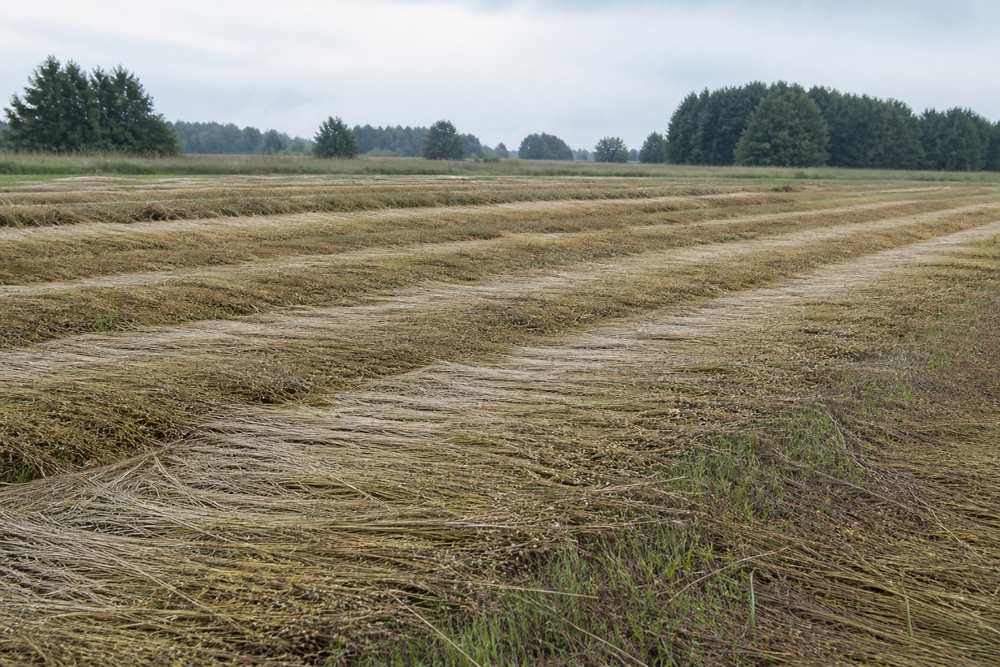
Dew retting is one of the essential stages in turning flax stems into linen fibre. After the flax crop is pulled from the ground, the stems are spread across the field and exposed to moisture, air and naturally occurring microorganisms. Together, these begin to loosen the bonds holding the valuable fibres to the woody centre of the stem.
The process looks simple, but its timing has a major influence on the quality and consistency of the fibre. Too little retting makes the fibres difficult to separate; too much can weaken or damage them. Farmers therefore monitor the crop closely as weather and microbial activity do their work.
For a complete overview of the journey from plant to cloth, read our guide to how linen is made.
What Is Retting And Why Does Flax Need It?
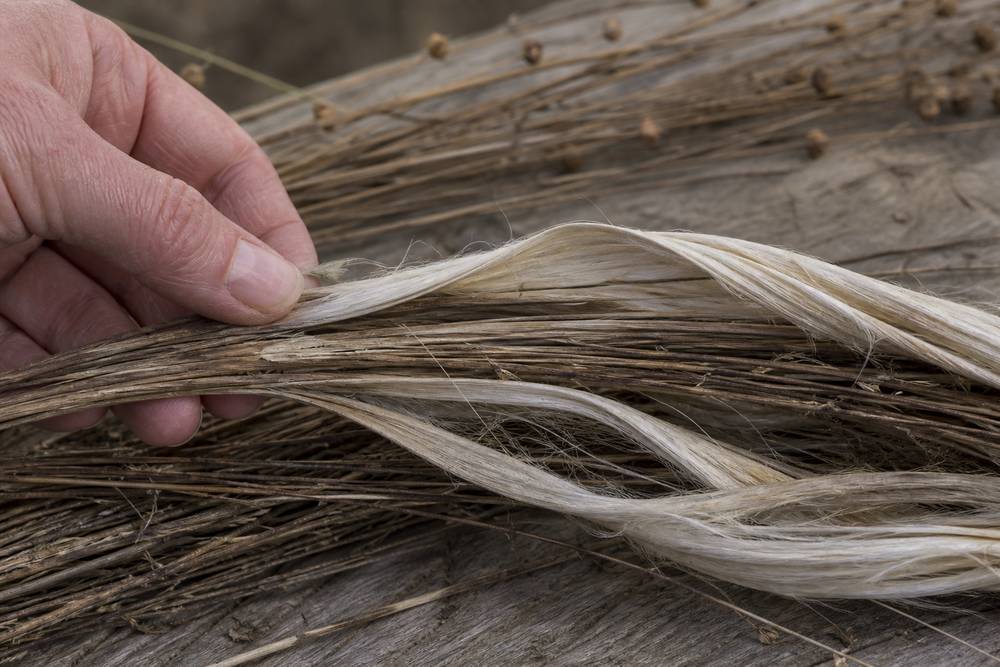
Flax is a bast-fibre plant. Its long textile fibres sit in bundles beneath the outer surface of the stem, surrounding a woody core known as shive. Pectins and other plant materials help bind these tissues together while the plant is growing.
Retting uses biological activity, moisture and time to break down enough of that binding material for the fibre bundles to be separated mechanically. Research identifies pectin degradation as a key part of the process. The cellulose-rich flax fibres should remain substantially intact while the surrounding tissues loosen.
Once retting is complete, the dried stems can move through breaking, scutching and hackling. These mechanical stages remove woody fragments, separate the fibre bundles and comb the fibres into a form suitable for spinning.
How Dew Retting Works Step By Step
Dew retting is also called field retting because the crop remains outdoors throughout the process.
- Pulling: fibre flax is generally pulled up with its roots rather than cut short, helping preserve the maximum useful stem length.
- Spreading: the stems are laid in thin, even rows or swaths across the field so moisture and microorganisms can reach them consistently.
- Moisture exposure: dew, rainfall and humidity wet the stems, while warmer and drier periods allow them to breathe and partially dry.
- Microbial activity: naturally occurring fungi and bacteria colonise the stems and produce enzymes that act on pectin-rich tissues around the fibre bundles.
- Turning: the rows may be turned so both sides receive more even exposure and retting progresses throughout the crop.
- Assessment: farmers test the stems repeatedly to judge how readily the fibre separates from the woody material.
- Collection: when the required retting level is reached, the flax is dried, baled and stored for later fibre extraction.
The exact timetable is not fixed. Studies commonly describe a process lasting several weeks, but local temperature, rainfall, humidity, soil conditions, flax variety and stem maturity all affect the pace.
The Role Of Microorganisms And Pectin
Dew retting is a complex biological process rather than the action of dew alone. Microorganisms already present on the plants, in the soil and in the surrounding environment become active when conditions are suitable.
Fungi play a particularly important role in field retting, although bacterial communities also change as the process develops. Their enzymes help degrade pectin and other non-cellulosic materials that hold the stem tissues together. This gradually frees the fibre bundles from surrounding cells and the woody core.
Research into fungi isolated from dew-retted flax found that several filamentous fungi could release fibres by producing pectin-degrading enzymes. More recent fibre-science studies likewise describe progressive microbial colonisation and significant changes in stem structure during the first weeks of retting.
Why Weather And Timing Matter
Dew retting depends heavily on field conditions. Regular moisture encourages microbial activity, while airflow and periods of drying help prevent the crop from remaining continuously saturated. Uneven weather can therefore produce uneven results across a field or even within the same row.
Under-retted flax remains difficult to process. The fibre bundles cling to the woody stem, requiring more mechanical work and increasing the risk of breakage during scutching. Over-retted flax may lose strength because microbial activity has continued beyond the point needed for clean separation.
Experienced growers assess colour, feel and the ease with which fibres pull away from the stem. Modern research also uses chemical, microscopic and mechanical measurements, but field judgement remains important because each crop and season behaves differently.
Dew Retting Compared With Water And Enzyme Retting
Dew retting is one of several ways to prepare bast fibres. Traditional water retting submerges stems in ponds, rivers or tanks, where mainly anaerobic bacteria help release the fibres. Controlled warm-water retting can work faster and may produce a lighter, more uniform fibre, but it requires substantial water management and creates organic effluent that must be treated responsibly.
Enzyme retting uses selected enzymes under controlled conditions to target binding materials. It offers greater process control and is an active area of research, but it requires equipment, inputs and careful management. Chemical methods can also work quickly, yet their environmental performance depends heavily on the chemicals, energy and wastewater systems involved.
Dew retting uses the field, ambient moisture and naturally present microbial communities instead of a retting tank. This can reduce direct water use and avoid concentrated water-retting effluent. However, it is slower and less predictable, so it should not be described as impact-free.
Is Dew-Retted Linen More Sustainable?
Dew retting can be a lower-input approach because it does not require large tanks of process water or the heating and chemical inputs associated with some alternative systems. It also takes place as part of the agricultural cycle, using local weather and biological activity.
The complete environmental picture is more complicated. Prolonged field occupation, repeated turning, machinery use, crop losses and variable fibre quality all matter. A poor retting season can reduce usable yield, and additional processing may be needed when fibres are inconsistent.
For this reason, the strongest claim is that dew retting can reduce some resource demands and wastewater impacts compared with conventional water or chemical retting. It is one part of a wider production system that also includes flax cultivation, mechanical fibre preparation, spinning, weaving, dyeing, sewing, transport and product lifespan. Read more about linen and responsible textile choices.
How Dew Retting Affects Linen Fibre
Dew-retted fibres often retain natural grey, silver, beige or brown undertones. Their colour varies with the flax, soil, weather, retting degree and later processing. This natural variation is part of the character associated with undyed linen rather than a reliable indicator of quality on its own.
Retting also influences cleanliness, fineness, strength and how readily fibres can be separated. The objective is not maximum decomposition; it is the right degree of retting for clean extraction while preserving useful fibre properties.
Careful sorting and mechanical preparation after the field stage help turn the variable agricultural material into more consistent fibre for spinning. The final handle and appearance of linen fabric then depend on many further choices, including yarn thickness, twist, weave, finishing and washing.
From Retted Flax To Woven Linen
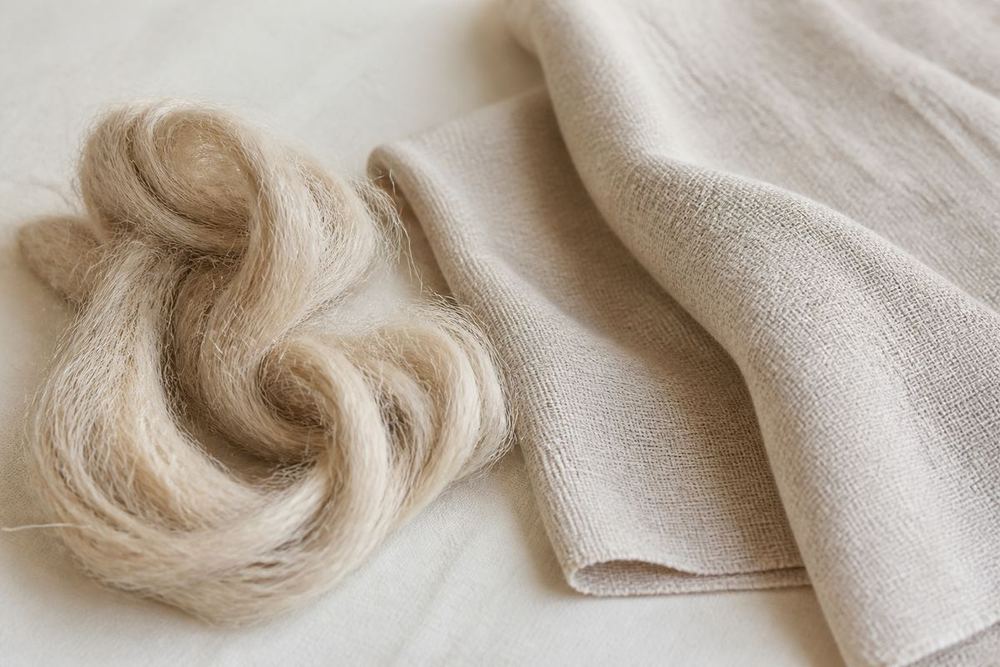
Retting prepares the stem for fibre extraction, but it is only the beginning. Breaking crushes the woody core, scutching removes much of the shive, and hackling combs and separates the long fibres. The prepared flax is then spun into yarn and woven or knitted into cloth.
Traditional looms and modern weaving equipment perform the same essential task: interlacing yarns to create a stable textile. The qualities we recognise in finished linen—its strength, texture, breathability and ability to soften with use—are shaped by every stage, beginning with the crop and the way its fibres were released.
Dew retting is therefore a quiet but decisive step in linen production. It combines agricultural knowledge, weather observation and microbiology, helping transform a flax stem into fibre that can continue its journey toward durable household and clothing textiles.